Veligonda Project — Transforming Andhra Pradesh's Drought-Hit Districts with Gravity-Fed Irrigation
Phase-I of the Veligonda Project became operational in August 2026, releasing Krishna water into Nallamala Sagar through Asia's longest underground irrigation tunnels. What does this mean for agricultural land in Prakasam, Nellore and Kadapa?
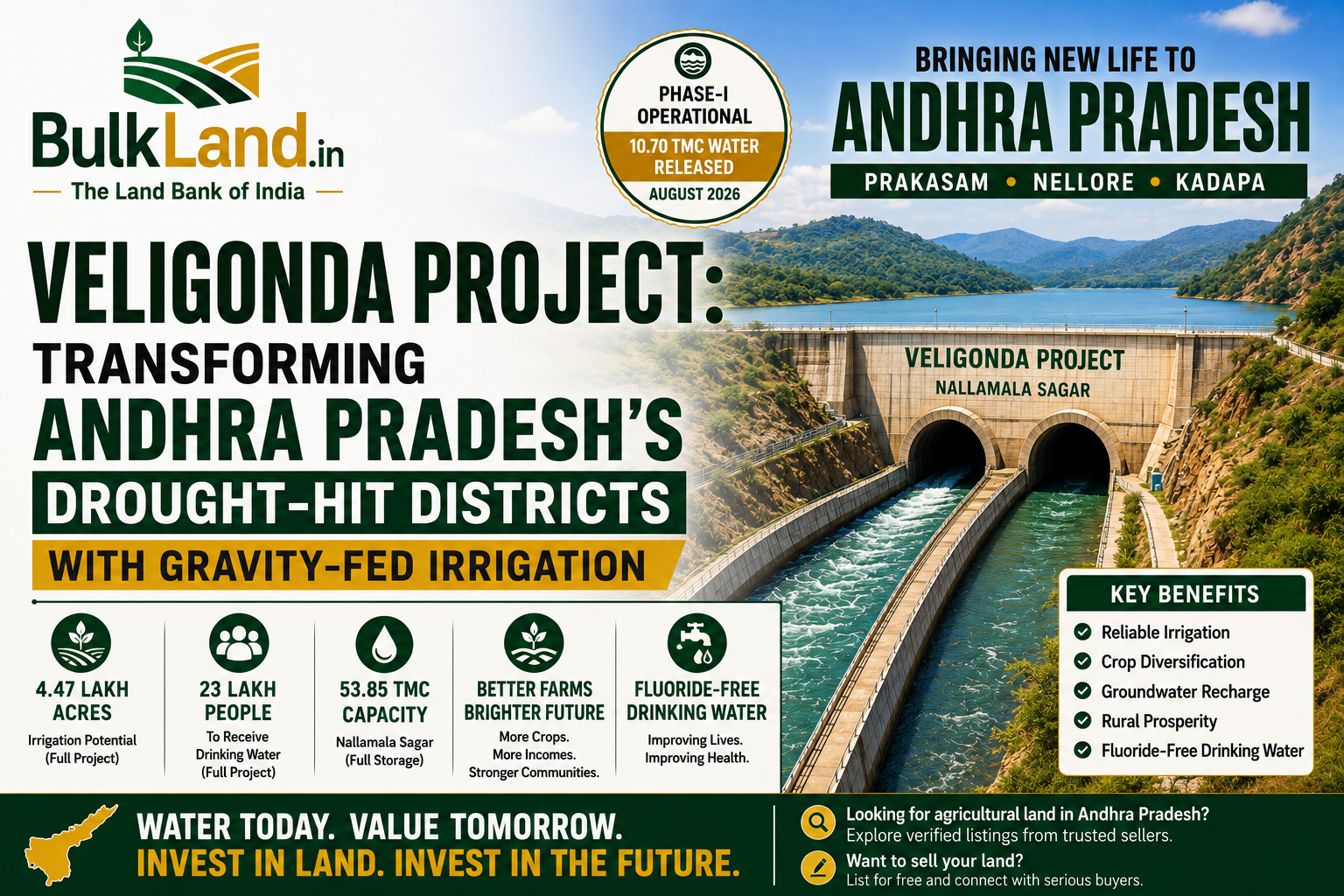
For nearly three decades, the Poola Subbaiah Veligonda Project has been under construction. In August 2026, Phase-I became operational, releasing Krishna River floodwaters into the Nallamala Sagar reservoir.
For the drought-prone areas of Prakasam, Nellore and Kadapa, this is more than an irrigation project. It could change the economics of agriculture — and potentially the value of agricultural land.
Why Veligonda Is Different
The Veligonda Project is designed to move Krishna water through the Nallamala hills using gravity flow, rather than relying on continuous pumping. Its most remarkable engineering features are two massive underground tunnels:
- Tunnel-1: 18.82 km
- Tunnel-2: 18.787 km
- Project cost: Approximately ₹10,200 crore
- Full storage capacity: 53.85 TMC
- Phase-I storage: 10.70 TMC
The twin tunnels rank among the longest underground irrigation tunnels in Asia. Construction faced a major setback when tunnelling encountered a difficult geological fault zone, resulting in a prolonged stoppage before specialised expertise was brought in to overcome the problem. Now, the critical infrastructure is moving into its operational phase.
Phase-I: Water Has Reached the Nallamala Sagar
Phase-I has brought 10.70 TMC of Krishna water into the Nallamala Sagar reservoir. The immediate planned benefits include:
| Benefit | Phase-I |
|---|---|
| Irrigation | 1.19 lakh acres |
| Drinking water | Around 4 lakh people |
| Major beneficiary areas | Prakasam, Markapuram, Nellore & Kadapa |
The larger project is designed to eventually provide irrigation to approximately 4.47 lakh acres and drinking water to around 23 lakh people across 30 mandals.
The Land Story Is Where It Gets Interesting
For agricultural land investors, the most important question is not how impressive the tunnel is. It is:
What happens when water reaches land that previously depended on rainfall?
The potential transformation is significant:
Rain-fed land → Assured irrigation → Higher cropping potential → Better farm economics → Greater demand for productive land
A striking example comes from Prakasam district. AgriGold acquired around 4,000 acres in the region decades ago when land prices were only a few thousand rupees per acre. Those properties are now reportedly being quoted at ₹15 lakh or more per acre.
The example illustrates the possible scale of transformation when long-awaited irrigation infrastructure changes the agricultural potential of an area. It should not, however, be interpreted as a guaranteed return for every parcel.
What Could Change on the Ground?
- More Productive Agriculture — Land previously limited by rainfall can potentially support more consistent cultivation
- Crop Diversification — Farmers may have greater scope to move beyond dryland crops and explore horticulture and higher-value activities
- Better Water Security — Dependence on uncertain rainfall and groundwater can reduce where canal water is actually available
- Agro-Processing Potential — Greater agricultural production can create opportunities for storage, processing and transportation
- Stronger Land Demand — If productivity and farm incomes improve, demand for productive agricultural land can gradually strengthen
Not Every Acre Will Benefit Equally
This is perhaps the most important point for land buyers. The project may cover several districts, but district-level proximity does not mean a particular parcel will receive Veligonda water.
The real opportunity lies in identifying land that is:
- Within the actual command area
- Scheduled to receive canal water
- Supported by suitable soil and agricultural conditions
- Accessible by road
- Not merely located near a proposed canal alignment
Survey-number-level verification is far more important than simply hearing that a village is "near Veligonda."
The Next Stage Could Be Even More Significant
Phase-I is only the beginning. As the distribution network develops, Phase-II is expected to expand irrigation coverage substantially, with the overall project eventually targeting 4.47 lakh acres of irrigation and drinking-water benefits for around 23 lakh people.
This means the land-market impact may unfold gradually rather than all at once. The most interesting locations could therefore be areas where irrigation is moving from promise to actual delivery.
What Should Land Investors Watch?
For buyers looking at agricultural land in the Veligonda influence area, three questions are particularly important:
- 1. Is the land actually within the Veligonda command area?
- 2. Has water already reached the land, or is it dependent on future phases?
- 3. Has the local land price already factored in the expected irrigation benefit?
The opportunity is not simply "Veligonda land." It is productive land that genuinely gains access to Veligonda water.
Beyond Irrigation
The project's impact could extend beyond farming. Improved agricultural productivity can support rural employment, horticulture, food processing, transportation and local commerce. The drinking-water component is equally significant for communities that have faced long-standing groundwater quality problems, including fluoride-related concerns.
Veligonda is not just moving water. It has the potential to move an entire regional economy.
The Bottom Line
After decades of construction, the Veligonda Project has entered a new phase with Phase-I becoming operational in August 2026. For the drought-prone areas it serves, the most important change may be simple:
Water is beginning to reach land that needed it most.
For landowners and buyers, that creates a potentially important agricultural story — but one that must be evaluated at the village and survey-number level, not simply by district.
The real question is no longer whether Veligonda will transform the region. It is which parcels will benefit first — and whether today's land prices have already recognised that transformation.
Looking for Agricultural Land in Andhra Pradesh?
Explore agricultural land listings or post your requirement on BulkLand.in — The Land Bank of India.
Browse Andhra Pradesh Land Listings
The project figures, land-price examples and projections in this article are based on publicly reported information available as of September 2026. Actual irrigation coverage, project timelines and land values may vary by location. Buyers should independently verify command-area status, water availability, title, land classification and local market values before any transaction. This article does not constitute investment, legal or financial advice.