Seven Sisters — Many Opportunities, Beyond Tourism
The Northeast's seven states are undergoing a connectivity transformation through new highways, railways and airports — creating land opportunities in agriculture, logistics, food processing and border trade that go far beyond tourism. A state-by-state analysis.
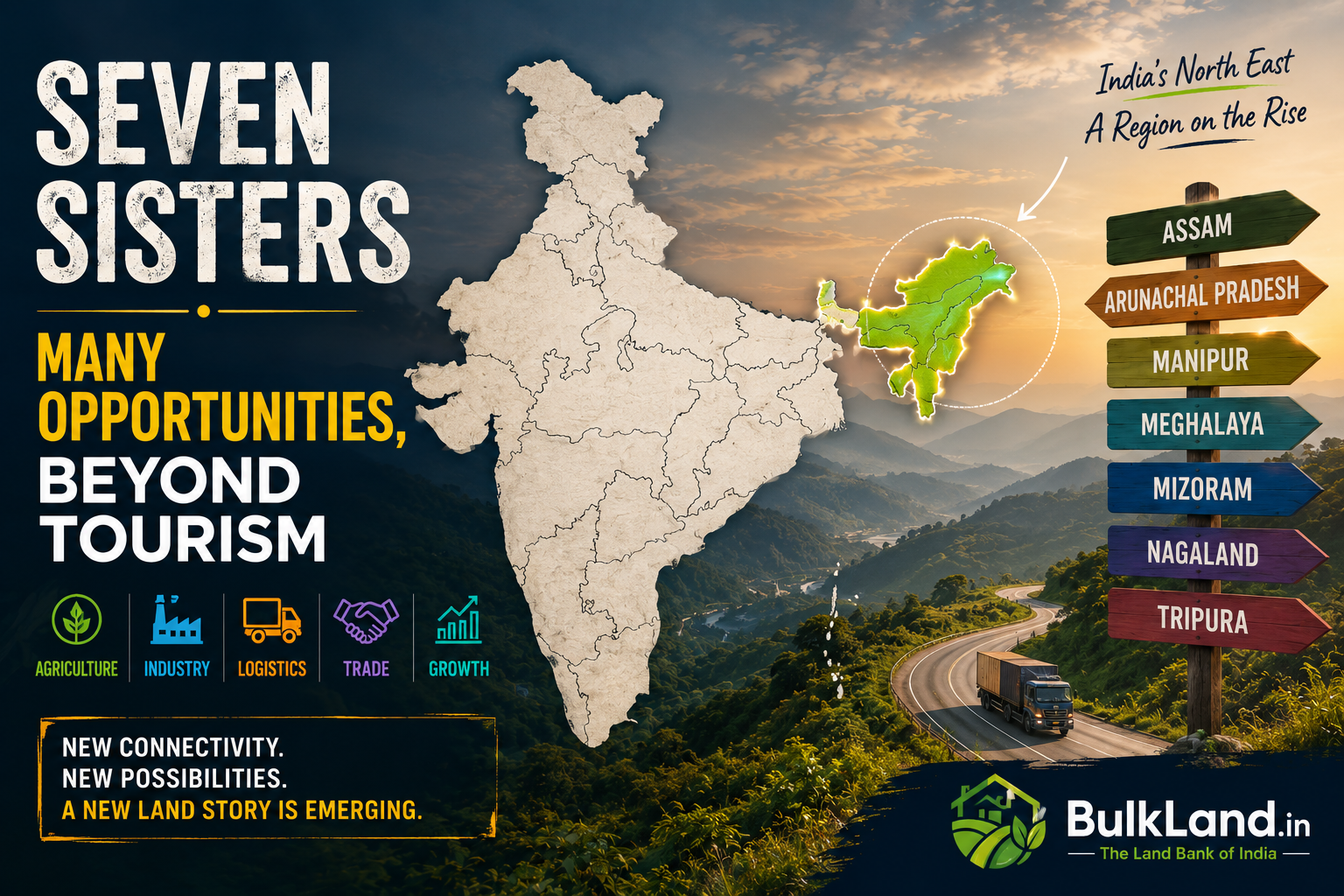
For decades, India's Northeast was geographically close to the rest of India — but economically, it often felt far away. Today, that distance is shrinking. New highways, railways, airports, bridges, border infrastructure and logistics projects are changing how people, goods and businesses move across the region.
And that creates a much bigger story than tourism.
Agriculture can reach larger markets. Factories can move goods more efficiently. Warehouses can come closer to emerging corridors. Food-processing businesses can locate closer to farms. Commercial centres can develop around new transport nodes.
The transformation is already visible. Across the Northeast, the National Highway network increased from 10,905 km in 2014 to 16,207 km by March 2025, while 46,296 km of rural roads were constructed under PMGSY during the decade. Railway investment has also increased sharply, with several new lines connecting or approaching state capitals.
The interesting question for the land market is therefore not simply: "What is beautiful in the Northeast?" It is: "Which locations are becoming economically more useful because connectivity is improving?"
Here is a state-by-state look at the Seven Sisters — and the land opportunities emerging around their changing economic geography.
1. Assam — From Gateway to Manufacturing and Logistics Hub
Assam has traditionally been the gateway to the Northeast. But its role is now becoming much larger.
What Has Changed?
Guwahati's new international airport terminal, inaugurated in December 2025, has been designed to handle up to 13 million passengers annually. The Union Cabinet approved a Rs 8,970-crore, 135.87-km four-lane access-controlled Guwahati-Tezpur corridor in August 2026. Rail capacity is also expanding, while the Jogighopa Multi-Modal Logistics Park is part of the region's emerging freight infrastructure.
And perhaps the most significant development is happening at Jagiroad. Tata Semiconductor Assembly and Test's facility represents a proposed investment of around Rs 27,000 crore, with planned large-scale semiconductor assembly and testing capacity.
What Does This Mean for Land?
Assam's opportunity is no longer only about Guwahati's residential expansion. It includes industrial land, warehousing and logistics, food-processing units, agro-processing, cold-chain facilities, manufacturing ancillaries, commercial development and land around emerging transport corridors. Agriculture also has a major role — Assam has substantial potential in rice, mustard, pulses, horticulture and plantation-based activities.
Land Insight: Assam may be the Northeast's first major example of land demand moving from "city expansion" towards "industrial + logistics + agricultural value-chain expansion."
2. Arunachal Pradesh — Roads Are Opening a Frontier Economy
Arunachal Pradesh has a completely different land story. Its challenge has never been lack of natural resources or economic possibilities. It has been access. That is changing.
What Has Changed?
The Sela Tunnel, dedicated in 2024, provides all-weather connectivity on the Tezpur-Tawang route. The Frontier Highway (NH-913) is being developed across the state, with multiple packages under execution or preparation. Rail connectivity is also being extended towards Pasighat, while the Donyi Polo Airport has already changed air access to the Itanagar region.
What Does This Mean for Land?
Arunachal is not merely a tourism opportunity. Its terrain supports opportunities in horticulture, kiwi and other high-value fruits, large cardamom, ginger, bamboo, vegetables, agro-processing, cold chains, local logistics and border-related infrastructure.
There is local evidence of strong appreciation around the Itanagar-Naharlagun urban region. Land prices in prime localities have risen sharply over the past decade. That does not mean the same appreciation applies across Arunachal.
Land Insight: In Arunachal, the important question is not "Is the land scenic?" It is "Is the land becoming connected?" That distinction could become increasingly important as the road network expands.
3. Manipur — Rail, Highways, Agriculture and the Moreh Opportunity
Manipur's land economy has been severely affected by the state's recent social and security disruptions, so this state requires a more cautious assessment. But its underlying infrastructure story remains significant.
What Has Changed?
The 111-km Jiribam-Imphal railway project, one of the Northeast's most challenging railway projects, is progressing — including major tunnels and the spectacular Noney railway bridge. NH-37 between Imphal and Jiribam is also undergoing improvement. The Imphal-Moreh corridor has strategic significance because Moreh is India's major land gateway towards Myanmar.
Agricultural Opportunities
Manipur has agricultural opportunities that are barely known outside the Northeast — Chakhao black rice, pineapple, horticulture, ginger, vegetables, pulses, oilseeds, bamboo and allied products. In 2025, ICAR released RC Manichakhao-1, a new high-yielding semi-dwarf black-rice variety developed specifically for Manipur.
Research on the Moreh corridor has documented that land prices along the highway from Imphal towards Moreh had risen as entrepreneurs anticipated commercial growth and border trade. The current security situation, however, makes this a high-risk, high-caution market.
Land Insight: Manipur's future land story may not be dominated by tourism. It could increasingly involve rail connectivity + border trade + agricultural branding + food processing + logistics.
4. Meghalaya — A Highway Can Change the Economics of the Hills
Meghalaya may be the clearest example of why infrastructure matters to land. Its natural attractions have existed for centuries. The new factor is accessibility.
What Has Changed?
In 2025, the Union Cabinet approved the Rs 22,864-crore, 166.8-km Shillong-Silchar Greenfield High-Speed Corridor. The project runs through Meghalaya and Assam and is designed to improve connectivity towards Tripura, Mizoram and Manipur while strengthening logistics and industrial activity. In 2026, the state also announced major highway investments including the proposed Shillong-Silchar and Jorabat-Barapani corridors.
The Agricultural Opportunity
Meghalaya has commercially valuable crops that deserve much more attention — Lakadong turmeric, ginger, pineapple, Khasi mandarin, tea, arecanut, black pepper, large cardamom, off-season vegetables and mushrooms.
This creates opportunities beyond simply building hotels. Think: collection centres, processing, packaging, cold storage, transport, regional markets.
Land Insight: A parcel near a new highway may become valuable not because somebody wants to build a resort there, but because farm produce can reach a market faster and a processing business can operate more efficiently. That is a much more interesting land story.
5. Mizoram — The Railway Has Changed the Equation
Mizoram has perhaps witnessed one of the Northeast's most important recent connectivity milestones. Aizawl is now on India's railway map.
What Has Changed?
The 51.38-km Bairabi-Sairang railway line was completed and inaugurated in September 2025, connecting Mizoram's capital region to the national railway network for the first time. The line includes numerous tunnels and bridges and has already generated strong passenger demand.
The railway is not merely about passengers. It can potentially change the economics of moving goods — ginger, turmeric, Mizo chilli, bamboo, rubber, horticultural produce, processed food, sericulture products and other agricultural commodities.
There is direct evidence from Mizoram itself. A Government of India assessment of PMGSY roads reported that surveyed villages in Champhai district experienced at least 10-15% increases in land prices after road completion.
Land Insight: When transport costs fall, agricultural land can acquire new economic value — not because the soil changed, but because the market became closer.
6. Nagaland — Coffee, Chilli, Food Processing and the New Rail Corridor
Nagaland is becoming an emerging agri-business and speciality-product economy — a story that deserves much greater attention.
What Has Changed?
The Dimapur-Kohima railway project is progressing, and the Kohima-Dimapur highway is undergoing major improvement including the Kohima bypass. These projects can reduce the economic friction of moving people and goods between the two centres.
The Agriculture Story
Nagaland is producing products with surprisingly strong commercial potential. Coffee — already reaching international markets. Naga King Chilli, pineapple, ginger, large cardamom, kiwi, avocado, soybean, millet and turmeric. The state is also expanding Naga King Chilli cultivation and processing across several districts.
The future opportunity therefore includes coffee plantations, horticulture, food processing, chilli processing, warehousing, agricultural collection centres, packaging, logistics and commercial land around transport corridors.
Land Insight: Nagaland could surprise outsiders because its future land economy may be built as much around speciality agriculture and processing as around tourism.
7. Tripura — From Landlocked State to Trade and Agro-Processing Gateway
Tripura may have one of the most commercially interesting stories in the Seven Sisters. Its geography gives it a natural advantage: Bangladesh is next door.
What Has Changed?
The Maitri Setu at Sabroom has been completed, creating a direct road connection with Bangladesh. The Agartala-Akhaura railway connection has also strengthened cross-border connectivity, while the Agartala-Sabroom railway line creates a stronger north-south transport spine.
The Pineapple Mission
In May 2026, the government launched the Rs 236-crore Tripura Queen Pineapple Mission — not simply a farming scheme. It includes collection centres, cold storage, reefer logistics, grading, processing, packaging, traceability, export readiness, GI branding and pineapple-based value-added products. A central hub is planned near Agartala airport.
Tripura also has substantial rubber, tea, bamboo and horticultural potential. The state government is actively promoting rubber value addition and developing tea-related infrastructure.
Land Insight: Tripura's opportunity may ultimately be much bigger than tourism — a combination of agriculture + processing + logistics + border trade + industry that can create demand for land at several points of the value chain.
The Real Opportunity Is Not Seven Tourist Destinations
The Seven Sisters should not be viewed simply as seven beautiful states waiting for tourists. They are seven different economic systems undergoing a connectivity transformation.
| State | Key Opportunity |
|---|---|
| Assam | Semiconductors + logistics + manufacturing + agriculture |
| Arunachal Pradesh | Frontier connectivity + horticulture + infrastructure + trade |
| Manipur | Rail + border trade + agriculture + food processing |
| Meghalaya | Highways + horticulture + processing + logistics + tourism |
| Mizoram | Rail + agriculture + processing + rubber + bamboo |
| Nagaland | Rail + coffee + speciality agriculture + food processing |
| Tripura | Bangladesh connectivity + pineapple + rubber + tea + industry |
Why Infrastructure Matters to Land
There is a simple economic chain behind all of this: Infrastructure leads to connectivity, which leads to lower travel and transport costs, which leads to a larger market, which leads to new business activity, which leads to employment, which leads to greater land demand.
Sometimes the effect is immediate. Sometimes it takes five or ten years. And sometimes a project produces little benefit because the surrounding land lacks suitable zoning, water, access or economic demand.
That is why infrastructure should be treated as a land-value catalyst — not a guarantee of appreciation.
The Land Investor's Question Has Changed
Earlier, the question might have been: "What is the land worth today?" Increasingly, the better question is: "What will this location be connected to five or ten years from now?" And an even better question is: "What businesses can operate here once that connectivity arrives?"
- A farm beside a new highway may become a logistics location
- A horticulture belt beside a railway may support processing and cold storage
- A village near an industrial corridor may attract workers, services and warehouses
- A border town connected to a new trade route may develop an entirely new commercial economy
The land does not change. Its economic reach does.
Looking Ahead — What Buyers Should Verify
The Northeast is still at an early stage of this transformation. That means there will be opportunities — but also considerable risk. Before buying, always verify:
- Exact project alignment and current construction status
- Distance from the property and actual access roads
- Land classification, ownership and title
- State-specific ownership restrictions
- Environmental and forest restrictions
- Water availability and local economic activity
- Feasibility of the intended business
Do not confuse a proposed infrastructure project with completed infrastructure.
The Northeast Land Story Is Just Beginning
The Seven Sisters have always had natural resources, fertile pockets, distinctive crops, skilled communities and extraordinary landscapes. What is changing now is access. And access can change economics.
The next decade may produce a very different land map in Northeast India — one shaped not only by cities and tourism, but by railways, highways, logistics, food processing, speciality agriculture, manufacturing, border trade and new markets.
The Northeast is not simply becoming easier to visit. It is becoming easier to do business in. And that could be the beginning of a very different chapter for its land economy.
Looking for Land in Northeast India?
Explore agricultural, commercial, industrial and other land opportunities on BulkLand.in, or post your land requirement to connect with landowners directly.
BulkLand.in is a land listing platform. Buyers should conduct independent legal, technical and on-ground due diligence before entering into any transaction. This article is for general informational purposes only and does not constitute legal, financial, tax or investment advice. Infrastructure projects do not guarantee land-price appreciation. Land values vary by location, title, land-use permissions, connectivity, demand, project execution and local economic conditions. State-specific land ownership and development regulations can also differ substantially. Always verify the current legal position, infrastructure status and physical condition of any property before entering into a transaction.