Ken-Betwa Link Project: New Irrigation Potential for Agricultural Land in Bundelkhand
The Ken-Betwa Link Project is expected to improve irrigation across the drought-prone Bundelkhand region, creating long-term opportunities for agricultural productivity and land value appreciation. While the project offers significant potential, investors should carefully verify the command area, land title, and project timelines before making any investment decisions.
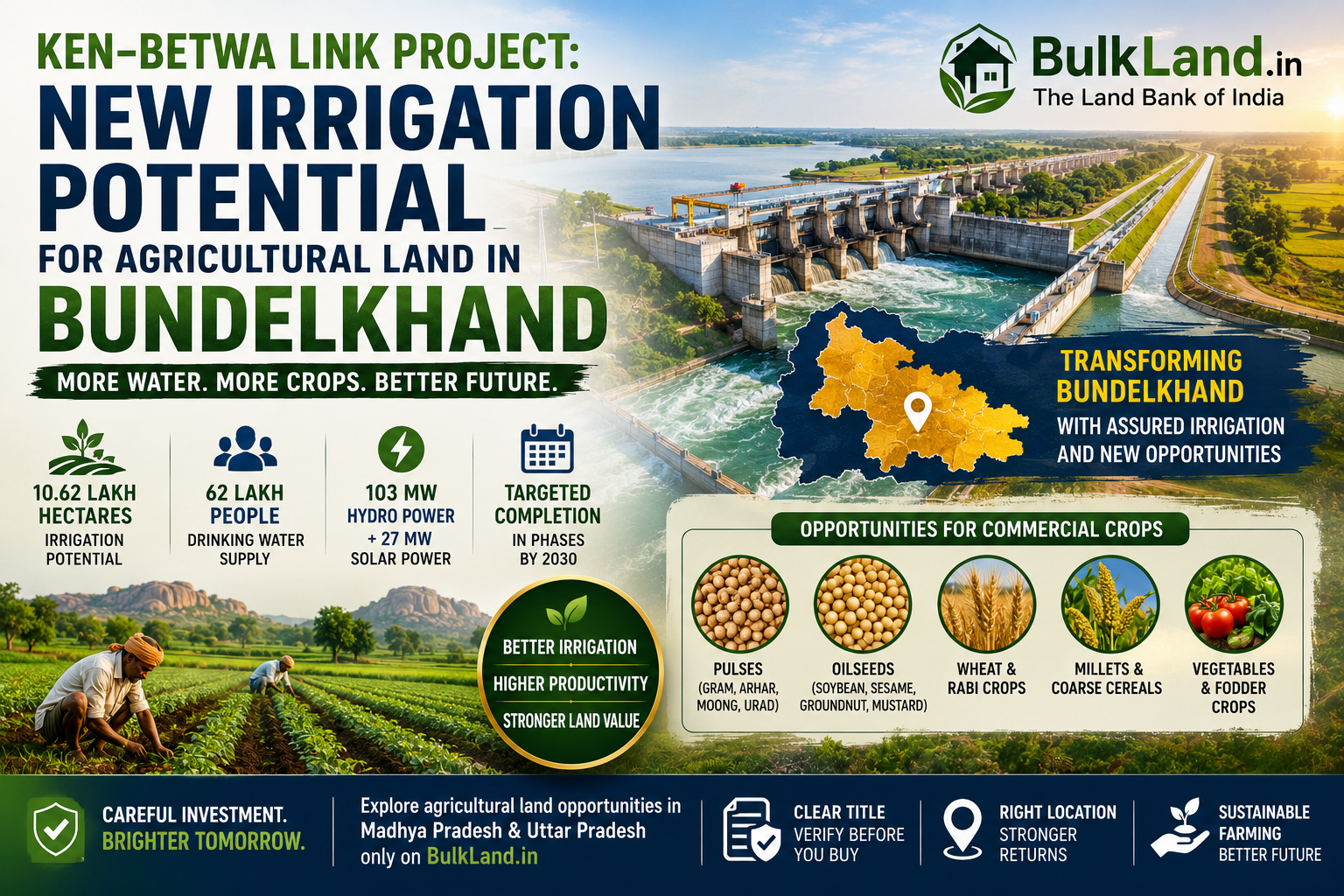
The Ken-Betwa Link Project is India's first major river interlinking initiative under active implementation. Designed to transfer surplus water from the Ken River to the water-scarce Betwa basin, the project aims to transform irrigation availability across large parts of the drought-prone Bundelkhand region spanning Madhya Pradesh and Uttar Pradesh.
Project Snapshot
- Estimated cost: Rs. 44,605 crore
- Key components: 77-metre-high Daudhan Dam on the Ken River, approximately 221 km link canal, and associated tunnels
- Irrigation benefit: Annual irrigation to about 10.62 lakh hectares (roughly 8.11 lakh ha in Madhya Pradesh and 2.51 lakh ha in Uttar Pradesh)
- Additional benefits: Drinking water supply for around 62 lakh people, 103 MW hydropower and 27 MW solar power
- Status: Construction is progressing. The Daudhan dam contract has been awarded and foundation-related works are underway. The project is targeted for completion in phases around 2030.
Once operational, the project is expected to stabilise and expand irrigation in parts of Chhatarpur, Panna, Tikamgarh, Niwari and adjoining districts in Madhya Pradesh, as well as Jhansi, Hamirpur, Banda and nearby areas in Uttar Pradesh.
Why This Matters for Agricultural Land
Bundelkhand has long faced erratic rainfall, limited irrigation coverage and high dependence on monsoon. Assured or improved canal irrigation can enable:
- Higher cropping intensity — potential for two or more crops in places that were largely single-cropped
- Shift toward more stable or higher-value crops
- Reduced risk for farmers and greater productivity per acre
For landowners and investors holding bulk agricultural parcels in the command or influence areas, improved water availability is one of the strongest long-term value drivers in the region.
Soil Types and Suitable Commercial Crops
Bundelkhand soils are predominantly mixed red and black. Common local classifications include:
- Red soils (Rakar and Parwa types): Generally coarser, lower in organic matter and fertility, prone to erosion. These respond well to soil management and irrigation.
- Black soils (Mar and Kabar types): Better moisture retention and higher clay content. More suitable for crops that benefit from good water-holding capacity.
With improved irrigation, the following crop groups are particularly relevant:
Pulses
Gram (chana), arhar, urad, moong and masoor remain well-suited to the region's soils and climate. These are relatively lower water-requirement crops and have strong market demand.
Oilseeds
Sesame (til), soybean, groundnut and mustard fit the agro-climatic conditions. Soybean and sesame have been noted in regional studies as relatively water-efficient options.
Millets and Coarse Cereals
Jowar, bajra and other millets perform well on red and mixed soils, especially under supplemental irrigation.
Wheat and Rabi Crops
With reliable irrigation, wheat including high-yielding varieties becomes more viable across larger areas, often in rotation with pulses or oilseeds.
Other Opportunities
In better-drained or managed black soil patches, limited cotton or vegetable cultivation may become more feasible. Fodder crops can also support mixed farming systems.
Farmers and landowners who combine irrigation access with soil testing, balanced nutrition and water-efficient practices such as drip or sprinkler irrigation are likely to see better outcomes than those relying solely on the canal network.
Key Considerations and Risks
- Timeline risk: Project benefits will materialise only after construction, canal distribution and command-area development are completed. Timelines can shift.
- Location matters: Not every parcel in the broader Bundelkhand region will receive direct canal irrigation. Location relative to the command area and distribution network is critical.
- Environmental and rehabilitation aspects of the project continue to be monitored. Buyers should stay informed about official updates.
- Title clarity: Land records and any acquisition or submergence notifications must be carefully verified before purchase.
- Soil health: Red soils in particular often need improvement in organic matter and nutrients for sustained productivity.
Bulkland.in is a listing platform only. We do not verify ownership, title, legal status or irrigation entitlement of any property. Always conduct independent legal, technical and on-ground due diligence before purchasing agricultural land.
Looking Ahead
The Ken-Betwa Link Project represents a significant infrastructure intervention in one of India's most water-stressed agricultural regions. For bulk agricultural land in the relevant districts of Madhya Pradesh and Uttar Pradesh, the long-term irrigation outlook is more positive than it has been for decades — provided buyers select parcels carefully and plan for realistic timelines.
Explore Agricultural Land in Bundelkhand
Interested in agricultural land in Bundelkhand districts of Madhya Pradesh or Uttar Pradesh? Browse verified listings in Madhya Pradesh or browse listings in Uttar Pradesh — or post your land requirement on Bulkland.in and connect directly with owners.