Evolution of India's Land Economy: 1947 to 2026
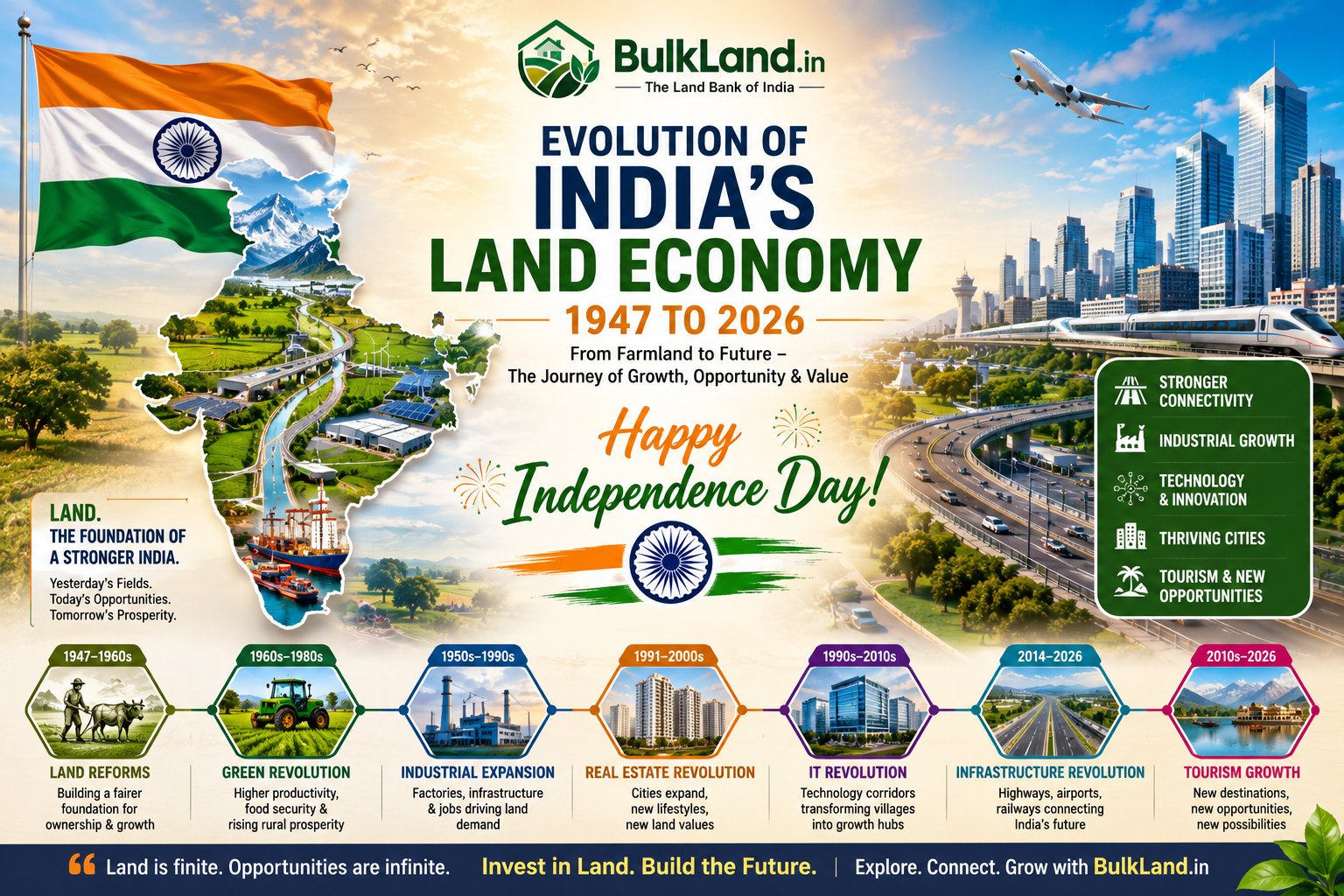
India’s land economy has transformed dramatically since 1947—from an agriculture-driven livelihood system to one shaped by industry, urbanisation, IT, infrastructure and tourism. This Independence Day special explores the major forces that changed the economic value of land and the emerging trends that could shape its future.
When India became independent in 1947, land meant one thing to most Indians:
Livelihood.
For millions of families, land meant farming, food and survival. Roads were limited, industries were few, cities were smaller and large parts of rural India remained disconnected from major markets.
Today, the same country has expressways crossing farmland, factories standing where villages once existed, airports transforming rural districts, technology corridors creating new cities and tourism opening up previously inaccessible regions.
What happened to India's land economy in these 79 years?
The answer lies in a series of transformations that changed not only how India used its land, but also what land was worth and why.
1. Post-Independence Land Reforms (Late 1940s to 1960s)
One of independent India's first major interventions was land reform.
The abolition of the zamindari and intermediary systems, tenancy reforms and other measures gradually changed ownership and cultivation patterns across different states. The implementation and impact varied considerably from one state to another.
These reforms were not primarily about increasing land prices.
They were about changing the relationship between the cultivator and the land.
For millions of rural families, having greater security and rights over the land they cultivated created the foundation for the next major transformation.
India was beginning to move from a feudal land structure towards a more productive agricultural economy.
2. The Green Revolution Made Productive Land More Valuable
Mid-1960s to 1980s
Then came the Green Revolution.
High-yielding seeds, irrigation, fertilisers, agricultural research and improved farming practices dramatically increased agricultural production in several parts of India.
Punjab, Haryana and western Uttar Pradesh were among the major early beneficiaries. The benefits subsequently spread to other parts of the country.
Something important happened to land during this period.
Water-rich and productive land became significantly more economically valuable.
Higher agricultural income enabled many farming families to improve their homes, educate their children, purchase equipment and invest in other businesses.
The Green Revolution demonstrated a principle that still applies today:
The value of agricultural land is closely connected to what the land can produce.
3. Industrial Expansion (1950s to 1990s, accelerating later)
As India built its industrial base, land acquired another role.
It was no longer only farmland.
Factories needed land.
So did industrial estates, power plants, ports, warehouses, worker housing and supporting businesses.
Mumbai, Pune, Ahmedabad, Vadodara, Surat, Chennai, Bengaluru, Hyderabad, Kolkata and several other centres gradually developed large industrial ecosystems.
And something interesting happened around these industrial centres.
Land surrounding factories also began acquiring greater economic importance.
A village located next to an industrial area could eventually become a commercial or residential growth centre.
The economic value of land was increasingly determined not only by what happened on the land, but also by what happened around it.
4. Real Estate Revolution (Especially post-1991)
Economic liberalisation accelerated private investment and transformed India's cities.
Housing projects, commercial buildings, offices, shopping centres, educational institutions and industrial developments expanded rapidly.
Mumbai, Delhi-NCR, Bengaluru, Hyderabad, Chennai and Pune became major engines of real-estate growth.
But perhaps the biggest change happened outside the traditional city limits.
Cities began moving towards villages.
Agricultural land on the outskirts of expanding cities increasingly came under pressure from urban development.
A parcel that had once been valued mainly for cultivation could acquire a completely different economic significance when roads, housing, industries and commercial activity reached its surroundings.
This was the beginning of India's modern peri-urban land economy.
5. The IT Revolution Created Entirely New Growth Corridors
Late 1990s to 2010s
Then India discovered another powerful engine of land demand:
Information technology.
Bengaluru's Electronic City, Whitefield and Outer Ring Road areas became famous examples.
Hyderabad's HITEC City and Gachibowli, along with technology corridors in Chennai, Pune and NCR, experienced similar transformations.
But IT companies did not create demand for office buildings alone.
Thousands of employees needed:
- Homes
- Schools
- Hospitals
- Restaurants
- Shops
- Transport
- Warehouses
- Entertainment
- Services
A technology park could therefore transform an entire surrounding region.
Jobs created people. People created infrastructure. Infrastructure created demand for land.
Villages that were once agricultural communities became part of major economic corridors.
6. Infrastructure Revolution (Particularly 2014 to 2026, continuing)
This may be the most visible transformation of the current era.
Expressways, highways, airports, railways, ports, logistics parks, industrial corridors and improved rural connectivity are changing the accessibility of thousands of locations. India's infrastructure network has expanded substantially over the past decade, with major growth in highways and operational airports.
And connectivity can change the economic equation of land.
A location that was once "too far away" has become "strategically located" after a new highway, airport, railway line or industrial project arrives.
This is why infrastructure has become one of the most closely watched factors in land investment.
But there is an important distinction:
Better connectivity is also creating new land opportunities in tourism-driven regions.
The Northeast, Jammu & Kashmir, Himachal Pradesh, Uttarakhand, Rajasthan and several coastal and heritage destinations are benefiting from improved accessibility and growing tourism activity.
As visitor numbers increase, demand can emerge for:
- Hotels
- Resorts
- Homestays
- Camps
- Restaurants
- Parking
- Local services
In some locations, land that was previously considered remote is acquiring new economic relevance.
But tourism-related land requires particular caution because environmental, forest, coastal and local planning regulations can significantly restrict development.
From 1947 to 2026: The Land Story Continues
India's land economy has therefore passed through several powerful waves:
- Land reforms changed ownership.
- The Green Revolution increased productivity.
- Industrialisation created manufacturing demand.
- Liberalisation accelerated urban expansion.
- IT created new economic corridors.
- Infrastructure connected distant regions.
- Tourism opened new destinations.
And the process is far from over.
The next major drivers could include:
- Logistics and warehousing
- Industrial corridors
- Renewable energy
- Data centres
- Electronics and semiconductor manufacturing
- New transport corridors
- Tourism infrastructure
- Agricultural modernisation
- Water-security projects
The important lesson is that land itself does not change, but its economic surroundings do.
Looking Ahead
The next phase of India's land economy will likely be shaped by continued infrastructure development, the growth of logistics and warehousing, renewable energy projects, data centres, tourism expansion and more careful planning around agricultural productivity and urban growth.
For landowners and investors, understanding which wave of change is currently affecting a particular region remains essential.
On this Independence Day, one truth stands out clearly:
Investing in land remains one of the strongest long-term options available. Land never fails when chosen with care and held with patience. Land is limited, and that scarcity continues to underpin its enduring value.
As India grows, the demand for productive, well-connected and strategically located land will only increase. Those who understand the forces that have shaped land values since 1947 will be better prepared for the opportunities that lie ahead.
Looking for Agricultural or Bulk Land?
Explore agricultural, industrial and commercial land opportunities on BulkLand.in, or post your land requirement to connect with landowners.
BulkLand.in is a land listing platform. Buyers should conduct independent legal, technical and on-ground due diligence before entering into any transaction.
Disclaimer
This article provides a broad historical and economic overview for general informational purposes only. Land values and land-use patterns vary substantially by location, timing, regulation and local economic conditions.
Nothing in this article constitutes legal, financial, tax or investment advice. Readers should conduct independent research and obtain appropriate professional advice before making any land-related decision.